It is a truth universally acknowledged that if you want to start a legend capable of outlasting two world wars, a handful of pandemics, and several waves of true-crime podcasts, the best approach is to be a slightly distracted Welsh fantasy writer on his way to Sunday Mass. And so it was that the phantom archers of Mons — one of the most gloriously daft supernatural legends in British military history — were born, entirely by accident, in the autumn of 1914.
A Battle, a Retreat, and a Very Productive Daydream
On the morning of 23 August 1914, the British Expeditionary Force collided with the advancing German army along the Mons-Condé canal in Belgium. The BEF was outnumbered, under-resourced, and — in the grand tradition of British military history — somehow muddled through anyway, holding the line long enough for their French allies to regroup and save Paris. It was the kind of desperate, last-ditch heroism that the British national psyche practically runs on, like tea and mild existential dread.
News of the battle took a full week to reach London. Meanwhile, a Welsh author named Arthur Machen — writer of gothic fantasy, enthusiast of the occult, and by his own admission a man capable of extraordinary woolgathering — saw the newspaper billboards on his way to church. Heavy losses. Desperate need for reinforcements. He sat in the pew, the incense curling overhead, and his imagination did what imaginations do when left unsupervised: it went completely off-script.
The Bowmen: A Story Nobody Was Supposed to Take Seriously
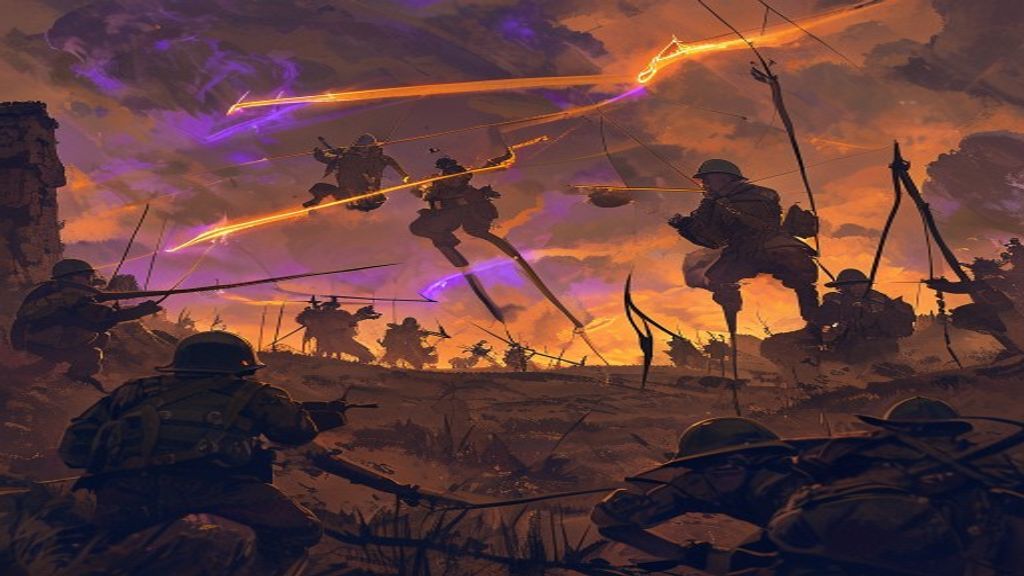
Machen went home and wrote The Bowmen, a short story in which the ghostly army of Agincourt — medieval English longbowmen, no less — materialise on the Western Front and mow down the German host with supernatural arrows. He called it an indifferent work. He was not wrong about the literary quality. However, he was catastrophically wrong about its impact.
The story was published in the Evening News in September 1914. Within months, it had escaped the realm of clearly-labelled fiction and gone feral across the British home front. Rumours spread that the bowmen were real. Then they became angels. Then they became the Angels of Mons — a fully-fledged supernatural intervention in which the Almighty Himself had apparently taken a side in the war, and had chosen Britain’s, which some felt confirmed long-held suspicions about the divine having impeccable taste.
When a Writer Says I Made It Up and Nobody Believes Him
Machen spent the rest of his life insisting, with increasing desperation, that he had invented the whole thing. Nobody was particularly interested. A rumour circulated that he had been tipped off by a military source. Another suggested a mysterious lady-in-waiting from the Royal household had slipped him the idea. A third — and this is a personal favourite — held that he had received a telepathic impression from the brain of a dying soldier on the battlefield. Furthermore, a researcher named Kevin McClure was still arguing in 1992 that Machen’s explanation was not the whole story. The man had been dead since 1947. He was still being disbelieved.
Meanwhile, on the other side of the Atlantic, Edgar Rice Burroughs — creator of Tarzan and a man clearly operating on a similar imaginative frequency — was independently writing about giant minds projecting legions of imaginary warriors to kill enemies through the power of suggestion in Thuvia: Maid of Mars. Consequently, two fantasy writers on separate continents had, entirely independently, decided that the best weapon in a modern war was a cloud of imaginary arrows. There is something deeply comforting about this.
The Phantom Archers of Mons and the Enduring Power of a Good Story
What the legend of the phantom archers of Mons really tells us — beyond the obvious lesson that writers should label their fiction more clearly — is something rather touching about how humans cope with the unthinkable. The Western Front was a place of almost incomprehensible horror. Moreover, people at home, powerless and terrified, needed to believe that something greater than artillery was watching over their sons and husbands in the mud.
A story about glowing medieval bowmen was, it turned out, considerably more comforting than the truth. You can hardly blame them. Even now, in a world of satellite imagery and rolling news, the phantom archers of Mons feel somehow more satisfying than the actual explanation, which is simply that a Welsh bloke had a daydream in church and wrote it down. As origin stories go, it is magnificently, irreducibly human.
Read the original story at The Fortean Times.
🛒 Related Finds on Amazon
As an Amazon Associate I earn from qualifying purchases.