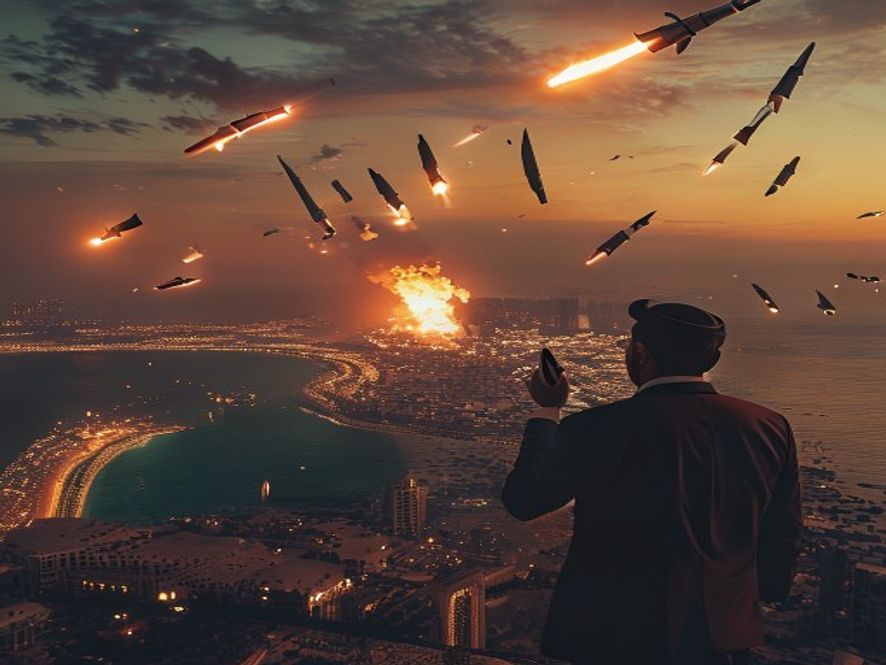
In what geopolitical scholars are carefully describing as ‘not great’, Iran attacks US sites in Bahrain and Kuwait on Sunday morning, lobbing ballistic missiles at American positions and generally doing very little to reassure anyone who had been quietly hoping the whole Middle East situation might sort itself out over a long weekend. Bahrain and Kuwait, to their considerable credit, intercepted the incoming missiles with the sort of calm efficiency that the rest of us reserve for dealing with a wasp at a barbecue. Nobody was reported killed, though a residential building near Bahrain’s international airport did sustain damage, which is the kind of detail that sounds almost manageable until you remember it is, in fact, a missile strike.
A Week That Nobody Put in the Diary
The Sunday morning fireworks did not, of course, emerge from nowhere. The week preceding it had already been something of a geopolitical car boot sale of chaos. On Thursday, an Iranian drone struck a Strait of Hormuz-transiting cargo ship flying a Singapore flag, which is precisely the sort of incident that makes shipping insurers weep openly into their spreadsheets. Then on Saturday, the United States accused Iran of hitting a Panama-flagged oil tanker, at which point the Americans decided enough was enough and launched their own strikes against Iranian drone sites. Furthermore, US Central Command helpfully clarified that their strikes were in direct response to continued Iranian aggression against commercial shipping, in case anyone had somehow concluded they were retaliating against something else entirely.
The Strait of Hormuz, for those who have not been following along, is one of the most strategically important waterways on the planet, through which approximately a fifth of the world’s oil supply flows. It had already largely ground to a halt since February, when the United States and Israel launched attacks on Iran. Consequently, global shipping has been experiencing what industry professionals call a thoroughly rotten time.
Trump Addresses Iran Attacks via Truth Social, As One Does
Meanwhile, President Donald Trump responded to the Iran attacks on US sites with characteristic subtlety, posting on Truth Social that Iran may have reached a point where he can no longer be reasonable. He warned, with the measured calm of a man who has just discovered someone ate his last biscuit, that the Islamic Republic of Iran will no longer exist if things escalate further. He also accused Iran of violating a memorandum of understanding that both he and Iranian President Masoud Pezeshkian had signed just eleven days prior on June 17th. Eleven days. That is, to put it gently, a remarkably short shelf life for a peace agreement. Shorter, in fact, than most supermarket yoghurts.
Iran’s Foreign Minister Abbas Araghchi, however, had a rather different reading of the same memorandum. Speaking at a news conference in Baghdad, he insisted that under the MOU, Iran alone is responsible for managing the Strait of Hormuz. He warned the US against interfering in shipping through the waterway and suggested that further American meddling could delay the full reopening of the strait. No other entity or country has any responsibility in this regard, he said, with the tone of a man explaining to a dinner guest that they are not, in fact, allowed to use the good cutlery.
What Happens When Iran Attacks US Sites and Everyone Has a Different Contract
The central absurdity here, and there is considerable competition for that title, is that both sides appear to be waving the same piece of paper and reading entirely different things from it. The Americans believe Iran violated the MOU by attacking commercial ships. Iran believes the Americans violated it by striking drone sites on Iranian soil. This is, in diplomatic terms, what experts refer to as a bit of a pickle. However, it is worth noting that the fragile agreement, signed barely a fortnight ago, had already survived roughly as long as a celebrity marriage before things went sideways. The BBC Middle East coverage has, understandably, been running at a considerable clip.
Bahrain and Kuwait, sandwiched between the competing egos of global superpowers, intercepted what they could and filed the necessary diplomatic complaints. One imagines their foreign ministers are sleeping rather poorly. The rest of the world, meanwhile, watches the Strait of Hormuz with the quiet anxiety of someone who has just remembered that their central heating runs on oil. As Iran attacks US sites and the US strikes back and memorandums flutter uselessly in the desert wind, the one certainty is that Truth Social will be kept very busy indeed.
Read the original story at UPI Odd News.
🛒 Related Finds on Amazon
As an Amazon Associate I earn from qualifying purchases.