Britain has produced some magnificently peculiar institutions over the years — the Flat Earth Society, the Monster Raving Loony Party, the entire House of Lords. But tucked somewhere near the top of that glorious pile of oddities sits the Fairy Investigation Society, a genuine, card-carrying, newsletter-printing organisation dedicated to tracking down fairies. Yes. Actual fairies. In London. In the 1920s. With membership certificates.
How the Fairy Investigation Society Was Born (Over Tea, Presumably)
It all began in 1927, when two of Britain’s most magnificently unhinged men found themselves in the same room. First: Quentin A. Craufurd, a retired Royal Navy officer of aristocratic stock who, when not sailing things, had conducted Britain’s first wireless broadcast from HMS Andromeda in 1907. A man of genuine scientific achievement, in other words. However, by the 1920s, Craufurd had pivoted — as one does — to receiving messages from the dead via radio. His colleagues in spiritualist circles called him ‘the wireless man’. His biographer, one imagines, called him ‘a challenge’.
The second gentleman was Bernard Sleigh, a Birmingham-based wood engraver of considerable talent who, following a brain operation in 1897, had begun experiencing what he described as ‘peculiar visions’ and subsequently declared himself psychic. Furthermore, he had written a book — The Gates of Horn — which fictionalised a society dedicated to investigating fairies. Craufurd read it. Craufurd loved it. Craufurd rang Sleigh and said, essentially, ‘What if we actually did this?’ And so they did.
Fairies, Fledglings, and a Secretary With a Criminal Record
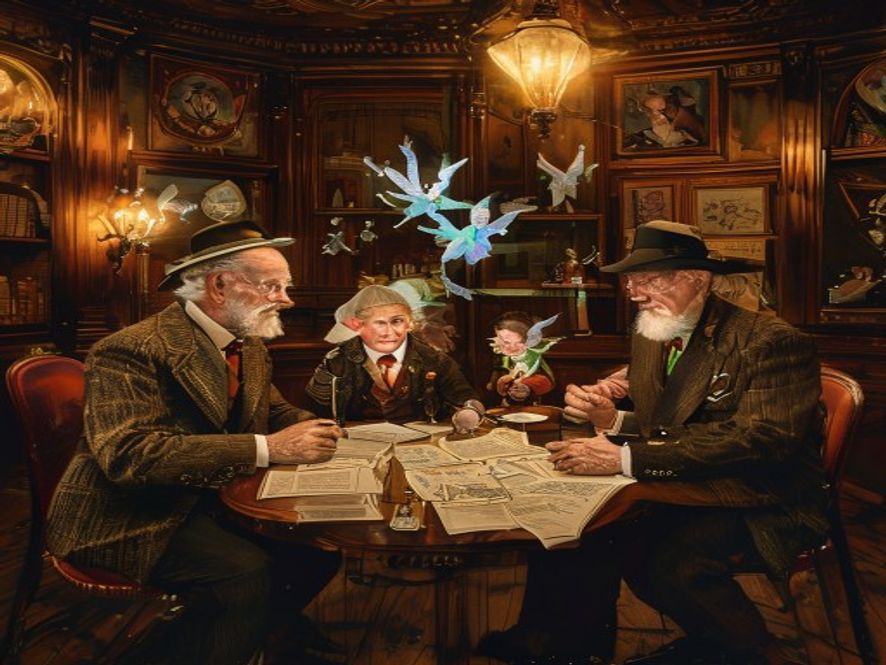
The Society took a couple of years to properly get going — these things can’t be rushed, particularly when you’re also communing with the deceased through a wireless set. By 1929, however, the London Lodge had printed its first newsletter. There were letterheads. There were membership certificates. There were, thrillingly, about fifty members willing to put their names to this enterprise and turn up to lectures at Five Smith Square.
The Society’s newly appointed secretary was one Claire Cantlon — described as a psychic with, brilliantly, a criminal record. Because if you’re going to investigate fairies in 1929, you absolutely want your administration handled by someone who has been in trouble with the law. Meanwhile, lectures were delivered by the likes of E.L. Gardner, who almost certainly produced the Cottingley Fairy photographs for what was probably not the first time that year, and one Tom Charman, who arrived bearing twenty-five ‘automatic’ fairy pictures. A Madame Zanoni also appeared. Nobody seems entirely sure who she was, which feels appropriate.
Not Your Grandmother’s Fairy Tales
It’s worth pausing here to note that these weren’t people cooing over sparkly winged creatures with tiny watering cans. Sleigh’s source book described fairies as dangerous, erotic, and frequently fatal — considerably closer to ancient British and Irish fairy folklore than to anything involving glitter and goodwill. Consequently, the Society attracted members who took a rather serious view of the matter, approaching the subject with the same energy a Victorian naturalist might bring to cataloguing beetles. Deadly serious. Completely barmy. Utterly loveable.
The whole enterprise would go on to conduct what it called a ‘Fairy Census’, accumulate a tabloid scandal at some point (naturally), and generally bumble through the decades with the cheerful determination of an organisation that has absolutely no idea how it looks from the outside. Which, of course, is the most British thing imaginable.
The Fairy Investigation Society: A Legacy Worth Celebrating
In a world of relentless, grinding sensibleness, the Fairy Investigation Society stands as a monument to magnificent human stubbornness. These were people — educated, earnest, and in at least one case, a decorated naval officer — who decided that fairies were worth investigating properly, and got on with it. You can read more about the broader world of Fortean curiosities if this has whetted your appetite for organised British weirdness. We salute them all.
Read the original story at The Fortean Times.
🛒 Related Finds on Amazon
As an Amazon Associate I earn from qualifying purchases.