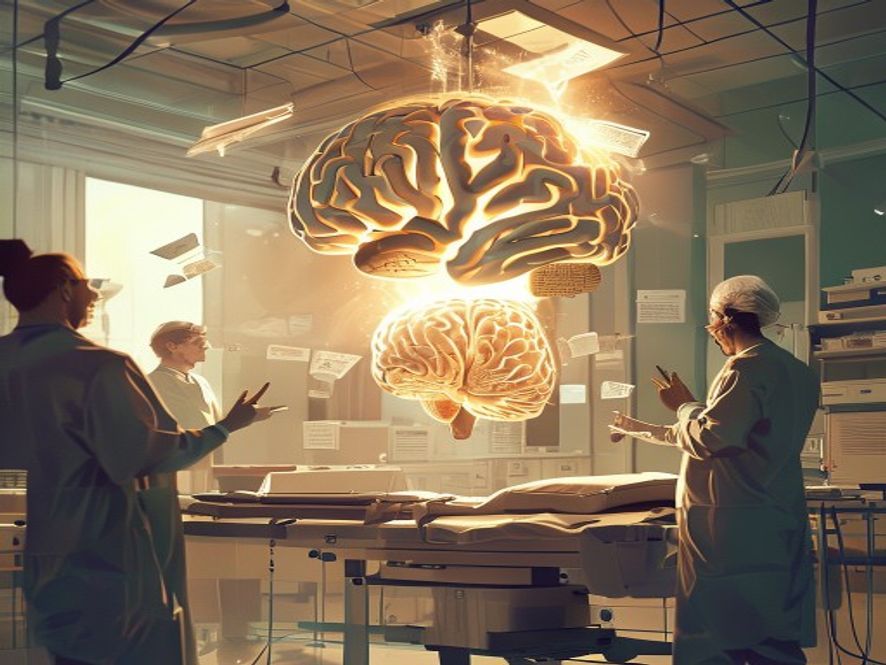
Scientists at Baylor College of Medicine have delivered what is arguably the most unsettling piece of news since someone told us coffee might be bad for us: brain activity under anaesthesia is far more advanced than anyone had previously suspected. While you are lying on an operating table, completely unconscious, blissfully unaware of anything, your brain is apparently sat in the corner doing its homework, processing language, analysing sounds, and generally making the rest of you look hopelessly lazy. Researchers published their findings in Nature, the journal scientists turn to when they want to ruin everyone’s comfortable assumptions.
What on earth is the unconscious brain actually doing?
The study involved recording the activity of hundreds of individual neurons in the hippocampus — the part of the brain responsible for memory, and apparently also for refusing to clock off. Researchers used something called Neuropixels probes, an impressively advanced bit of kit that had never before been deployed in the hippocampus during this kind of research. The patients were undergoing epilepsy surgery, which gave the scientists a rare and rather convenient opportunity to peer directly into the unconscious brain without anyone kicking up a fuss. What they found was frankly alarming. The brain was not resting. The brain was not having a lovely kip. The brain was, by all accounts, absolutely cracking on.
Furthermore, the recordings showed that even under general anaesthesia, the brain continued to process language and respond to sounds in the environment around it. This is the neural equivalent of your colleague who claims to be on holiday but keeps answering emails. Nobody asked you to, Brian. Nobody asked.
Brain activity under anaesthesia challenges everything we thought we knew
For decades, scientists and anaesthesiologists have operated on the fairly reasonable assumption that unconsciousness more or less equals cognitive downtime. General anaesthesia, after all, is specifically designed to switch the lights off upstairs. Consequently, the idea that the brain might be quietly running advanced language-processing subroutines in the background is — to use the technical term — a bit much. Dr. Sameer Sheth, professor and the sort of person who clearly did not get the memo about leaving work at the door, stated that even when patients are fully anaesthetised, their brains continue to analyse the world around them. He said this as though it were interesting rather than deeply, personally threatening.
The implications for our understanding of consciousness are enormous. Meanwhile, the implications for anyone who has ever muttered something embarrassing in the operating theatre are, frankly, best not dwelt upon.
So what does this mean for the future, apart from mild existential dread?
The researchers believe these findings could shape future work on memory, language disorders, and brain-computer interfaces — those futuristic devices that allow people to control technology directly with their thoughts, and which will inevitably end in catastrophe of some kind. However, on the more immediately useful side, a better understanding of what the brain gets up to during surgery could meaningfully improve anaesthetic care and help clinicians understand why some patients retain fragmented memories of their procedures. Which is an experience nobody has ever described as enjoyable.
There is also the tantalising and slightly terrifying possibility that this research could eventually help people with disorders of consciousness — conditions like comas — by revealing how much cognitive activity persists even when a person appears entirely unresponsive. You can read more about current research into disorders of consciousness if you fancy adding another layer of complexity to your Tuesday.
The brain: an overachieving organ we never quite deserved
In summary, brain activity under anaesthesia has proven itself to be considerably more sophisticated than the scientific community previously gave it credit for. Your brain, it turns out, is the kind of dedicated self-starter that lists unconscious language processing under skills on its CV. The rest of your organs are presumably deeply embarrassed. We certainly are. Science, once again, has looked at the human body and concluded that it is considerably stranger and more impressive than anyone was comfortable with — and written it up in a journal so we could all feel slightly inadequate about it together.
Read the original story at Weird Science News.
🛒 Related Finds on Amazon
As an Amazon Associate I earn from qualifying purchases.