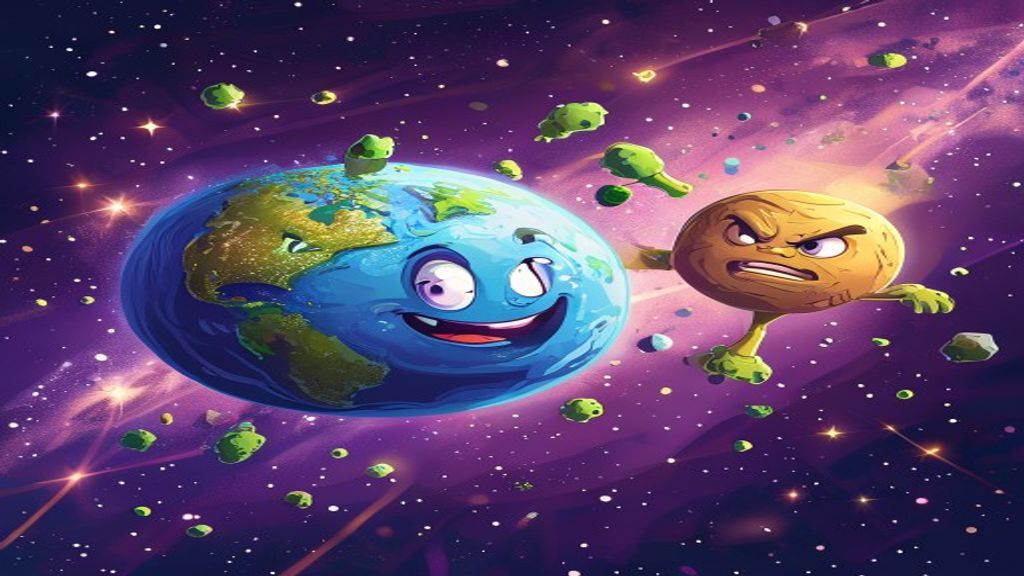
It turns out that Earth has been sending unsolicited biological packages to Venus for approximately four billion years, and nobody thought to mention it until now. Scientists studying the theory of panspermia — the wonderfully sci-fi notion that life hitchhikes across the cosmos aboard rocks — have concluded that Earth seeding Venus with life is not only plausible, it may have been happening on a frankly staggering scale. Roughly 20 billion microbial cells, they estimate, may have made the trip over the past billion years alone. Venus, for its part, has declined to issue a statement.
Rocks, Microbes, and the World’s Longest Postal Route
Here’s how it works, and do try to keep up because it’s simultaneously brilliant and completely bonkers. When something enormous — say, an asteroid the size of a moderately ambitious mountain — smashes into Earth, it blasts chunks of our planet’s surface clean into space. Some of those chunks contain microscopic organisms, tucked away inside like stowaways in the world’s most inadvisable gap year. These rocky parcels then drift through the solar system until gravity eventually delivers them somewhere else entirely.
Scientists have long debated whether this kind of transfer happened between Earth and Mars, which is already quite a lot to absorb over your morning coffee. However, researchers from Johns Hopkins University Applied Physics Laboratory and Sandia National Laboratories have now expanded the conversation to include Venus, and their findings are, to use the scientific term, absolutely mental.
The Venus Life Equation: Because One Impossible Equation Wasn’t Enough
To estimate the probability of life arriving on Venus from Earth, the team used something called the Venus Life Equation — essentially a cousin of the Drake Equation, which is famous for being the mathematical equivalent of a very educated shrug. The Venus Life Equation multiplies together several factors: the chance life originally got started on Venus, how robust any such life would be, and whether habitable conditions have persisted to the present day. Multiply enough uncertain numbers together and you get a number that is also uncertain, but with considerably more academic credibility attached to it.
Furthermore, the researchers had to consider whether any organisms could actually survive the journey. This involves tolerating ejection from a planet via catastrophic impact, drifting through the vacuum of space bombarded by radiation, and then entering Venus’ atmosphere in a fireball. Consequently, the microbes in question would need to be, and there is no polite way to put this, absolutely indestructible little weirdos. Fortunately, extremophiles — organisms that thrive in conditions that would kill everything else — suggest nature does produce exactly this type of resilient microscopic lunatic.
Billions of Cells, a Pancake Model, and Venus Looking Increasingly Suspicious
The team modelled how incoming space rocks — bolides, in the jargon — would behave entering Venus’ thick atmosphere. They used something called the “pancake model,” which describes how a fireball flattens out and fragments as it hurtles through the air. After an airburst, the resulting cloud of debris spreads into a flattened disc of material, which the researchers cheerfully refer to as “cells.” Meanwhile, their calculations suggest that about 100 viable cells might be dispersed into Venus’ clouds every single year. Over a billion years, that adds up to approximately 20 billion cells delivered from Earth.
Now, Venus is not exactly a hospitable destination. Its surface sits at around 465 degrees Celsius, the atmospheric pressure would flatten a submarine, and it rains sulphuric acid. However, the cloud layers above — roughly 48 to 60 kilometres up — are considerably more temperate, and scientists have genuinely been wondering whether microbial life could lurk up there like microscopic tourists who missed their stop.
Earth Seeding Venus With Life: What Does It All Mean?
The researchers are careful to note that every parameter in their equation carries significant uncertainty, and that their model doesn’t capture every atmospheric nuance. This is scientist-speak for “we’re not saying there’s definitely alien life on Venus, but we’re absolutely not NOT saying it either.” Earth seeding Venus with life over billions of years remains a genuine scientific possibility, which is the sort of sentence that would have got you laughed out of a conference room twenty years ago and now gets you a presentation slot at the Lunar and Planetary Science Conference. Science, as ever, continues to be a magnificent, chaotic endeavour. And somewhere above the clouds of Venus, a microbe that started its journey on Earth may be quietly getting on with things, entirely unbothered by any of this fuss.
Read the original story at Weird Science News.
🛒 Related Finds on Amazon
As an Amazon Associate I earn from qualifying purchases.