In the grand tradition of things that absolutely should not have worked but somehow did anyway — see also: the British railway system, folding a fitted sheet, and most of Boris Johnson’s career — the Memphis Belle bomber stands as one of history’s most magnificently improbable success stories. This was a ten-man crew strapped inside a flying metal tube, hurled repeatedly into the most dangerous airspace on earth, and yet they all came home for tea. Remarkable. Utterly, stupendously remarkable.
What Exactly Was the Memphis Belle Bomber?
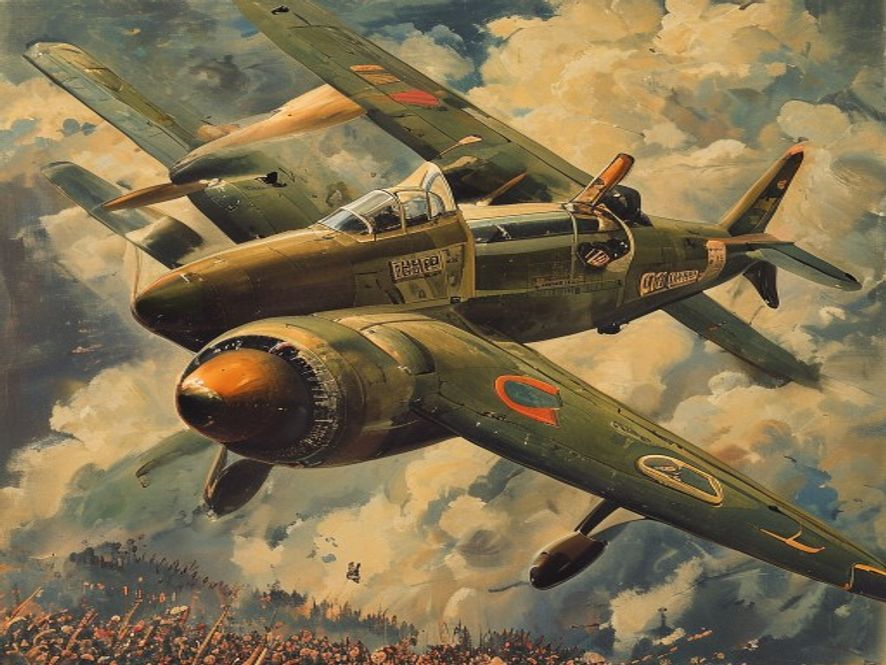
The Memphis Belle was a Boeing B-17F Flying Fortress, built in 1942 and assigned to the United States Army Air Forces. Pilot Robert K. Morgan, apparently a romantic of the highest order, named the plane after his girlfriend Margaret Polk, who hailed from Memphis, Tennessee. Morgan didn’t stop there. He contacted pin-up artist George Petty — because of course he did — and had an illustration from Esquire magazine painted onto the fuselage. Nothing says “ready for combat” quite like a bit of nose art, does it?
The crew of ten set off on their first mission on November 7, 1942, accompanied at base by their mascot: a Scottish terrier named Stuka. The dog, sensibly, did not fly on combat missions. She had more sense than the entire Luftwaffe, apparently.
The Odds Were Absolutely Horrifying
Here is where it gets properly sobering, before we return to being cheerful about it. During the Memphis Belle’s operational period, the Eighth Air Force lost one bomber every eighteen sorties. Roughly one in five airmen was killed in combat. With a crew of ten, statistics firmly suggested that at least two of them would not be coming home. Furthermore, a heavy bomber statistically didn’t even survive to its twentieth mission before being shot down. Twenty-five missions, therefore, was the sort of target that made actuaries weep quietly into their spreadsheets.
The Memphis Belle, however, had not read the statistics. Over the course of its tour, it flew 25 missions across Germany, France, Belgium, and the Netherlands. The plane was damaged on seven separate occasions. Tail gunner John Quinlan cheerfully recalled a bullet passing clean through his compartment. Consequently, every single landing was something of a minor miracle.
Coming Home: War Heroes Who Didn’t Want the Fuss
On June 14, 1943, the Memphis Belle landed safely on American soil, becoming the first World War II bomber to complete 25 missions and return home. The crew were immediately and enthusiastically declared heroes by a nation absolutely gasping for good news. Meanwhile, the crew themselves were characteristically modest about the whole business. Morgan wrote in his memoir that they were “simply young men who flew bombing missions and played poker and looked out for each other and maybe drank too much and chased too many women sometimes.” Which is, frankly, one of the most relatable mission statements in military history.
The crew embarked on a nationwide war bond tour, with crowds flocking to see the plane and its improbably alive occupants. Stuka the terrier came along for the ride, presumably enjoying the attention enormously. A documentary was released in 1944, later adapted into a 1990 Hollywood film, cementing the legend further.
Where the Memphis Belle Bomber Lives Today
Today, the restored Memphis Belle bomber sits proudly at the National Museum of the United States Air Force in Dayton, Ohio. It is a lasting symbol of wartime courage, statistical impossibility, and the enduring human talent for doing things that really ought not to be done. The nose art is still there. Stuka, sadly, is not. But we choose to believe she lived an extremely long and comfortable life, dreaming of low-altitude flights and the roar of engines overhead.
The Memphis Belle bomber remains, in short, the greatest argument ever made for simply refusing to acknowledge what the numbers say. Sometimes, apparently, the plane just comes home.
Read the original story at All That’s Interesting – Bizarre.
🛒 Related Finds on Amazon
As an Amazon Associate I earn from qualifying purchases.